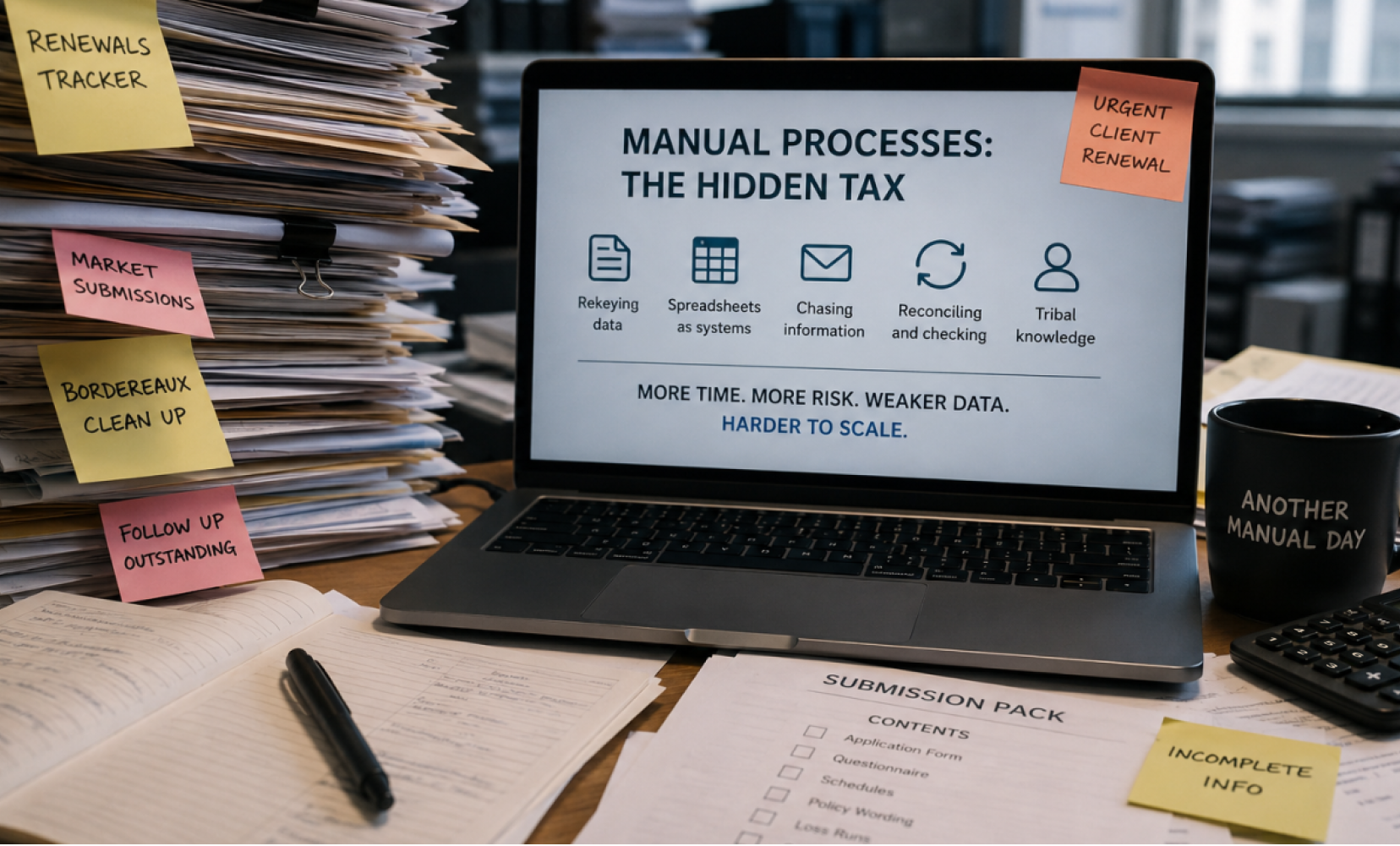
I speak to a lot of underwriting companies, but I’m yet to find one that’s completely happy with its operational processes and technology.
Of course, every business finds a way to get work done, but internal systems that are supposed to make the job easier often have the opposite effect. Instead it’s individual team members that often bridge the gaps left by technology: they chase information, move cases along manually and use their personal experience to know what should happen next.
Clearly that’s not a scalable way to operate, and it can get worse over time until, eventually, the business becomes dependent on these manual workarounds and one-off interventions.
If you’re hoping to spot the tell-tale signs before your company runs into these issues, here are seven indicators that your people and processes may be compensating for technology that no longer meets the needs of the business:
1. Email controls the process
Email is great for communicating with brokers and colleagues, but using it to control the underwriting process is a risky business.
Think about a typical process: a submission arrives in a shared inbox and is forwarded to an underwriter, more information is requested and, if the risk needs to be referred, another email chain begins. Before long, ownership becomes murky and the case history is scattered across multiple email threads. It may even be difficult to remember whether the risk is waiting for the broker, the underwriter or an approver.
This kind of process might be manageable while volumes are low, but the weaknesses become clear when demand rises or a key colleague is absent.
Email should support the process, not define it. Every case needs a clear owner, status and next step.
2. Underwriters spend more time on admin than assessing risk
Good underwriters create value through judgement. They interpret incomplete information, understand unusual exposures and decide which terms make sense.
Yet much of their time can be consumed by the less valuable work that surrounds the decision, like copying data between systems, chasing missing documents and assembling referral packs.
This work is necessary, of course, but it doesn’t require much underwriting expertise. The cost is not just inefficiency; it’s lost underwriting capacity.
3. Management can’t see the operation clearly
An underwriting leader should be able to understand what’s happening without hours of manual investigation.
How many submissions are awaiting review? Which referrals are overdue? Where is work beginning to build up?
If the answers depend on spreadsheet exports or conversations with individuals, management information is already behind the operation, and this is likely to cause real problems. A backlog could remain hidden until a broker complains, or an overloaded underwriter might continue receiving new work because nobody has a reliable view of their capacity.
Better visibility means seeing the current position while there is still time to act.
4. The process changes depending on who handles the risk
Underwriters should not all reach the same decision – their judgement is part of the value they bring. The process around that decision, however, should not vary unnecessarily.
Problems arise when team members follow different referral routes or store evidence in different places. For example, one underwriter may record an appetite decision in the policy administration system, while another keeps it in a personal spreadsheet.
The decision may be sound, but the process is difficult to govern. Training becomes harder, and audit evidence takes longer to assemble. Managers may also struggle to confirm that required checks even took place.
5. Small improvements require huge effort
Operational change should not always require a major technology project.
In many companies, even modest improvements are a challenge. If custom development is required whenever a workflow changes or a new product is introduced, delay and frustration are inevitable. That delay often leads to another workaround, adding complexity and ‘operational debt’.
Of course, insurers need control over process changes, but authorised teams should still have well-governed ways to make sensible configuration changes without waiting for a full software release.
6. AI pilots never become part of day-to-day underwriting
AI has huge potential in underwriting operations. It can extract information from documents, identify missing data and summarise complex submissions.
But a successful demonstration is not the same as a production-ready process.
What happens when confidence is low? Who checks the result? How does the output affect the next stage of the case?
An AI tool may read a submission successfully, but the operation still needs a controlled way to validate the output and handle exceptions. In short, the model needs a robust process in which to operate.
When promising pilots repeatedly fail to reach production, the wider operating environment may be the real constraint.
7. The core platform has become a reason not to improve
Many insurers know where their underwriting processes need attention, but improvement is delayed because the core policy administration platform is considered too big and important to change.
Instead, businesses add manual controls around the platform. The core system may still perform its primary role well, but when the limitations of the platform prevent the business from improving how work is managed, the operation has outgrown the available technology.
Modernisation does not have to begin with core replacement
Recognising these signs does not mean embarking on a multi-year transformation programme.
Many insurers are introducing an operational layer around the core platform instead. This can manage work across the policy lifecycle, improving visibility and providing a consistent way to control the process. It can also connect existing systems and create the structure needed for automation or AI to operate safely.
The principle is simple: technology should make underwriting easier to manage, rather than forcing the process to bend around system limitations.
If you’re thinking about how you can start making improvements to your underwriting operations, ask yourself whether your technology supports the underwriting process or whether your processes are covering up its shortcomings.
Build IT Now
Want to learn more about what we can do for your business? And how quickly? Go to the Systems iO services page or
Stay updated with our latest insights, industry news, and exclusive content by following us on LinkedIn! Join our growing community of professionals and be part of the conversation. Follow us on LinkedIn and never miss an update!
If you would like to receive our newsletter direct to your inbox, simply sign up at the bottom of this page..