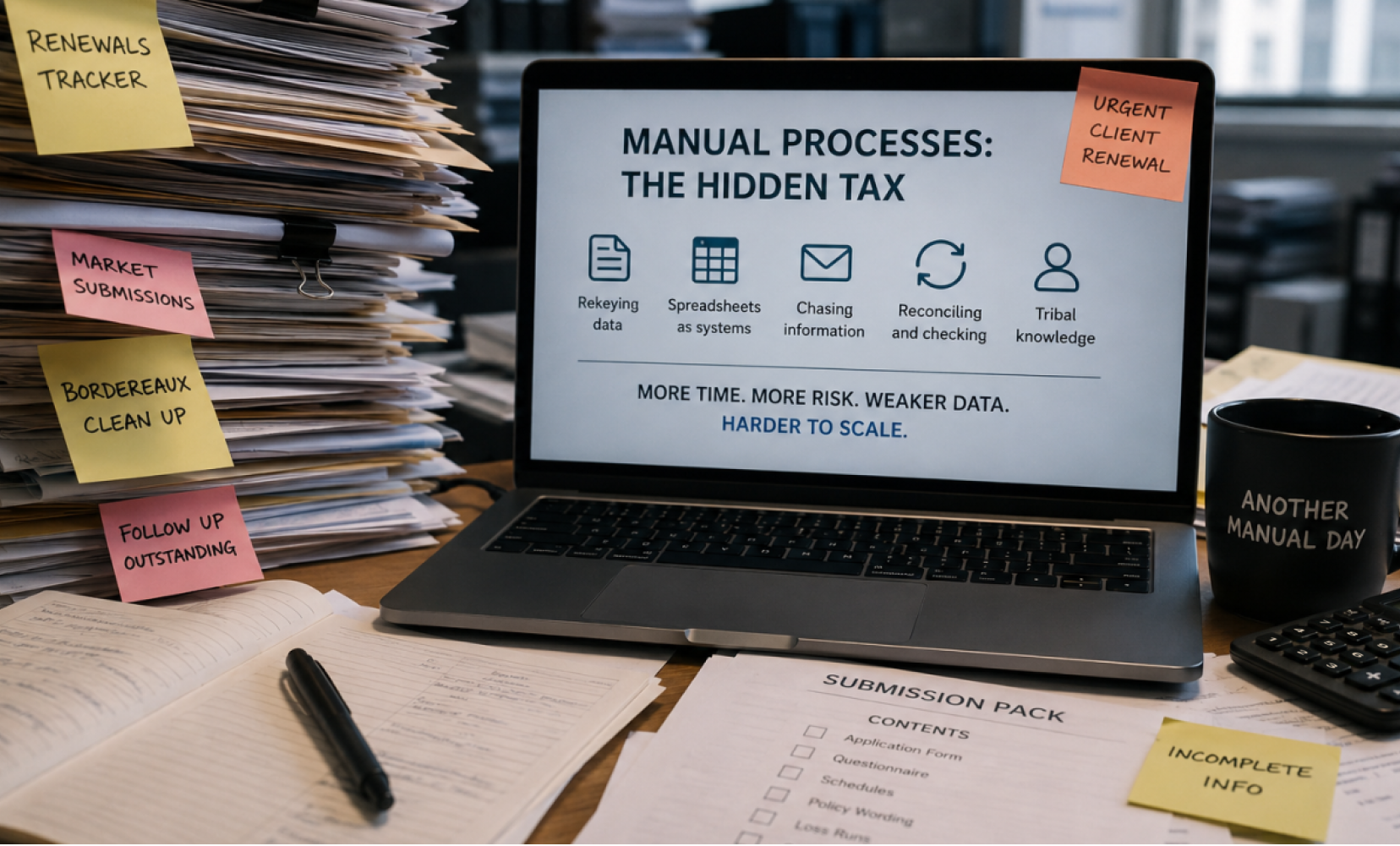
I’m often struck by how many “AI in insurance” conversations focus on something the industry has been doing for years: process automation.
Long before ChatGPT arrived on the scene, insurers were already using technology to pull fields, summarise emails or pre-fill templates. For admin-heavy environments, that’s undeniably useful. But it isn’t what you would call “transformative”.
The real shift comes when organisations move beyond automating individual tasks and start delegating outcomes.
Agentic AI and renewals
When people talk about “agentic AI”, they’re describing systems that can take a goal and work towards it with a degree of independence. They gather context, decide what steps are needed, and keep progressing until something meaningful is ready for human review.
In underwriting, one of the clearest examples is the production of renewal documentation, which sounds routine on paper, but in practice, rarely is.
The information needed to produce a renewal pack is spread across multiple sources. Some of it sits neatly in the policy administration system. Some arrives through broker emails. The rest tends to be buried in attachments, prior-year documents or hastily written notes. It’s rarely clean, and it’s almost never complete, yet the output still needs to be consistent and accurate.
A quote needs to reflect the correct terms and assumptions. The policy must align with what was actually agreed. The invoice has to match the premium and fees. Certificates must carry the right details. When something is off, even slightly, it leads to rework, back-and-forth with brokers, and avoidable risk.
Traditional automation can be a great help. It can extract data from a document or move a case through a workflow. But it typically operates in straight lines, performing one action at a time without much awareness of the bigger picture. And one thing we can be sure of is that a renewal rarely follows a straight line.
From tasks to objectives
The process might involve spotting that an address has changed in an email but not in the system. It might mean comparing this year’s submission with last year’s schedule, identifying gaps, and chasing missing information. It often requires pulling together multiple sources before anything can be produced with confidence. This is exactly where agentic AI starts to make a difference.
Instead of instructing software to carry out a specific task, you can set an objective: prepare the renewal documentation pack for review.
From there, the system works out what’s required. It pulls the policy record, reviews correspondence, interprets attachments and checks for inconsistencies. It drafts the relevant documents and highlights what has changed, what is missing and what needs attention before anything is finalised.
The key difference is context. Rather than lifting a value from a single source, it checks that value against others and flags conflicts. Rather than generating a document in isolation, it understands what should exist at that stage of the process and applies the appropriate template. And when information is missing, it doesn’t stall, it prepares the next step, whether that’s a query or a recommendation.
The role of the underwriter
It’s important to note that none of this removes the underwriter from the process: if anything, it sharpens their focus. Underwriters are there to apply judgement: assessing risk, setting terms, negotiating with brokers and handling exceptions. Yet a significant portion of their time is still spent piecing together information and assembling standard outputs. That’s the part of the job that agentic AI is perfectly suited to take on.
Of course, in a regulated environment, autonomy needs clear boundaries. The goal isn’t to allow systems to act unchecked. It’s to create a controlled layer that prepares, compares and recommends, while keeping key decisions and external communications within defined authority. Done properly, this approach not only improves efficiency but also strengthens governance.
Every output can be traced. You can see where data came from, how conflicts were handled and who approved the final result. That level of transparency isn’t optional, it’s essential if AI is going to be trusted in production.
The perfect starting point
For most insurers, renewals are a practical place to start. They’re frequent, document-heavy and familiar, which makes them a good proving ground for a more outcome-driven approach. Of course, automation will continue to make individual steps faster, but Agentic AI changes something more fundamental: it transforms the way we approach the whole process.
For underwriting teams, that’s the real shift: from asking systems to “populate this field” to asking them to “get this ready for review”. And when that happens, the benefits are straightforward. Work moves more quickly, errors become easier to catch, governance improves, and underwriters get more time to focus on the high-impact decisions that actually matter to the business.
Build IT Now
Want to learn more about what we can do for your business? And how quickly? Go to the Systems iO services page or
Stay updated with our latest insights, industry news, and exclusive content by following us on LinkedIn! Join our growing community of professionals and be part of the conversation. Follow us on LinkedIn and never miss an update!
If you would like to receive our newsletter direct to your inbox, simply sign up at the bottom of this page..